Cosmetic · 12 May 2026
Teeth whitening: what works, what damages, what is a waste
Charcoal powder, lemon and baking soda are not whitening your teeth. They are removing them.
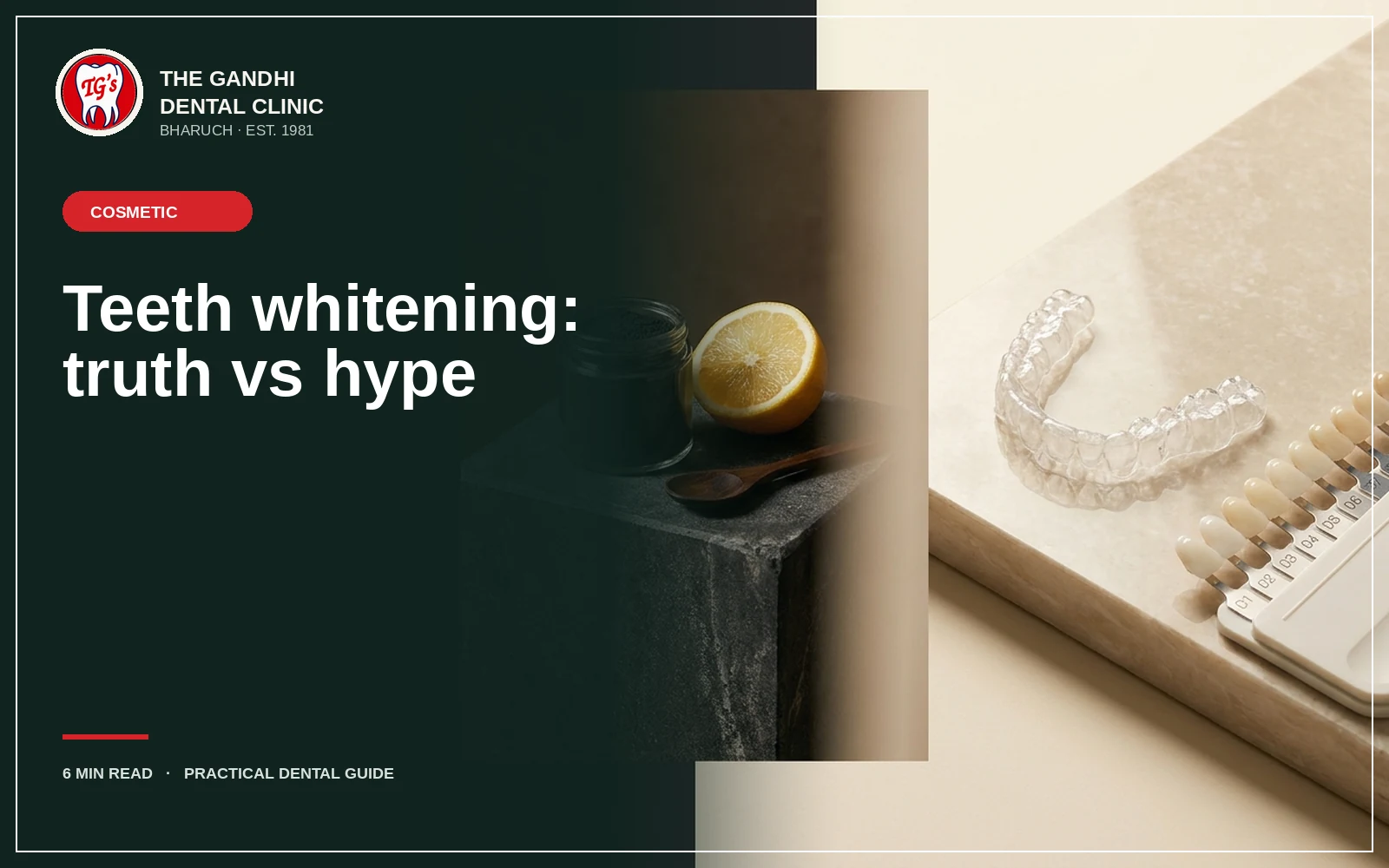
Two different things get called whitening, and confusing them is why people end up disappointed. Cleaning removes surface stain and returns teeth to their natural shade. Whitening changes the natural shade itself. If your teeth are stained from tea, tobacco or pan, a professional clean may be all you need.
Why teeth are the colour they are
Enamel is translucent. The colour you see is largely the dentine underneath showing through, and dentine is naturally yellowish and darkens with age as it thickens. Brilliantly white teeth are not the human default, and the shade people bring in from photographs is often not achievable on a natural tooth.
What actively damages teeth
- Charcoal powder. Abrasive. It scrubs enamel away, and thinner enamel lets more yellow dentine show — so teeth end up darker and more sensitive.
- Lemon juice, vinegar, baking soda. Acid dissolves enamel. The brightening you notice is etched, roughened enamel that then stains faster.
- Unregulated whitening kits. Concentration is often unknown and ill-fitting trays leak gel onto the gums, causing chemical burns.
- Anything applied by someone who is not a dental professional — including salon and beauty-parlour treatments. Nobody screens for the cavity or cracked filling the gel is about to seep into.
What actually works
Professionally supervised whitening using carbamide or hydrogen peroxide, either in the chair or with custom trays made from an impression of your own teeth. The custom tray is the important part — it keeps the gel on the teeth and off the gums.
Before starting, decay and gum problems must be treated. Whitening gel reaching an exposed nerve through a cavity is a genuinely awful experience.
The thing to sort out before you start
Whitening does not change crowns, veneers or fillings. If you have a crown on a front tooth, whitening the teeth around it leaves the crown looking darker and more obvious than before. Sometimes the right sequence is whiten first, then replace the restoration to match. That conversation belongs at the start, not afterwards.
Sensitivity, and how long results last
Temporary sensitivity is common and settles within a few days of finishing. Shorter sessions and desensitising gel reduce it. It is not a sign of damage when the process is supervised.
Results typically hold for a year or two depending on tea, coffee, tobacco and pan. Occasional top-ups with the same trays maintain it cheaply.
When whitening is the wrong answer
Internal staining from an old injury or a root-treated tooth does not respond to external whitening — that needs internal bleaching or a veneer. Tetracycline banding responds poorly. And a single dark tooth among normal ones is a different problem entirely. An honest assessment tells you which of these you have before you spend anything.
General information only. It is not a substitute for an examination — book an appointment for advice about your own teeth.
Common questions
Questions people ask

Gandhi Dental Clinic · Bharuch
Care built overgenerations.
Plan your visit with our dental team.