Symptoms · 27 July 2026
Why toothache always gets worse at night
It is not your imagination, and it is not because you are thinking about it more. There is a mechanical reason.
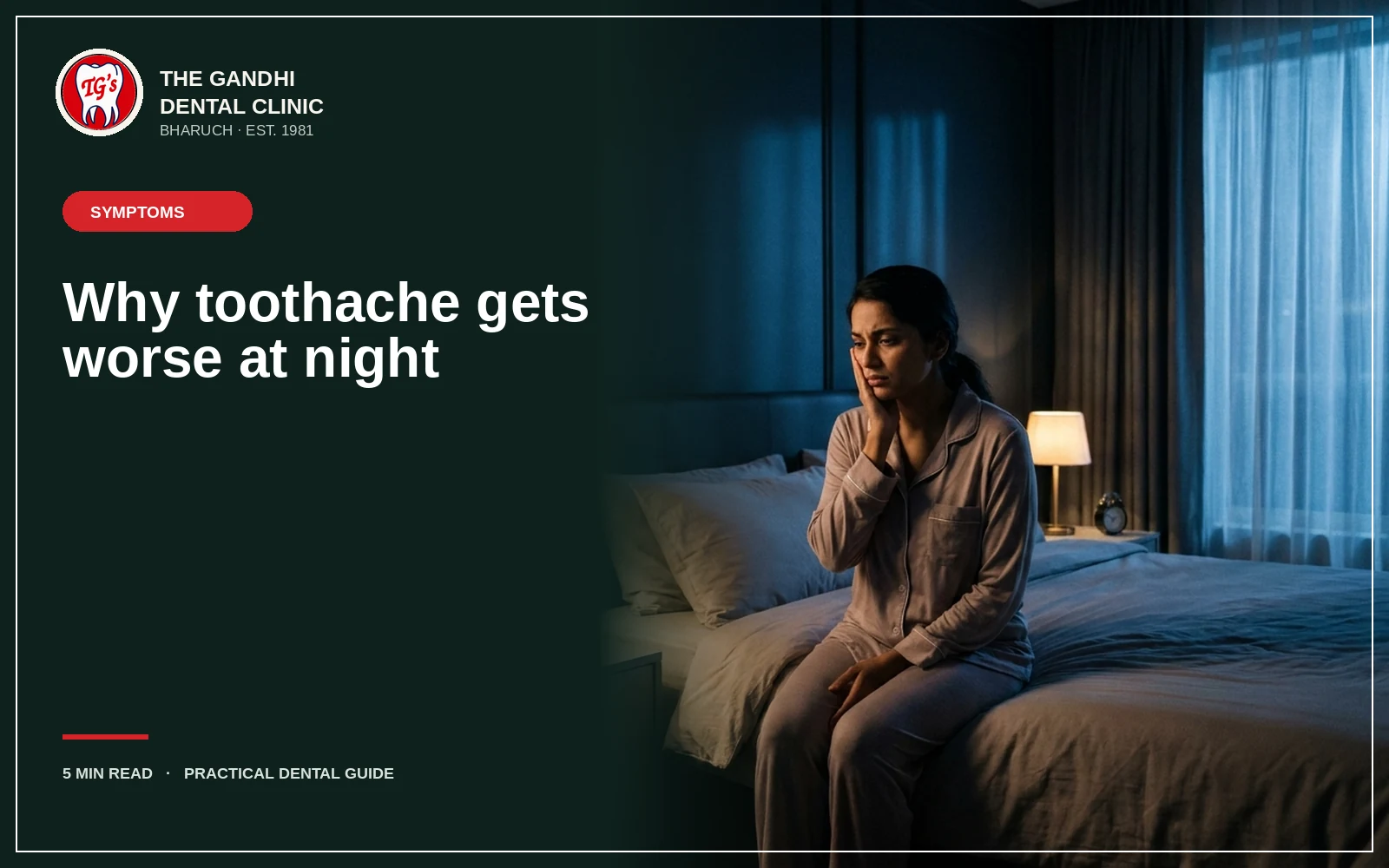
Almost every patient who arrives with severe dental pain says the same thing: it was bearable all day and unbearable at two in the morning. That pattern is so consistent it is close to diagnostic.
The reason is blood pressure in your head
When you lie down, blood flow to the head increases. In a healthy tooth you would never notice. In a tooth where the pulp is inflamed, the tissue is already swollen inside a rigid chamber that cannot expand. Any additional pressure has nowhere to go, and the nerve reports it as throbbing pain.
There is a second factor: during the day you are distracted. At night there is nothing else competing for your attention.
What the pattern tells a dentist
- Sharp pain that stops the moment the trigger is removed — cold, sweet — usually means sensitivity or a shallow cavity.
- Pain that lingers for minutes after cold suggests the pulp is inflamed and may not recover on its own.
- Spontaneous throbbing that wakes you is the classic presentation of irreversible pulpitis. That tooth generally needs a root canal or an extraction.
- Pain on biting, plus swelling points to infection that has reached beyond the root tip.
What helps tonight
Sleep propped up on an extra pillow rather than flat — it genuinely reduces the pressure. Take whatever pain relief you normally tolerate, at the correct dose and correct interval, and take it before the pain peaks rather than after. A cold compress on the outside of the cheek helps if there is swelling.
Two things to avoid. Do not put an aspirin against the gum — it burns the tissue and does nothing for the tooth. Do not apply heat to a swollen face; it encourages the infection to spread.
What does not help, whatever you have been told
Clove oil dulls the surface briefly and does nothing to inflamed pulp inside the tooth. Rinsing with salt water is soothing for gums and irrelevant to a dying nerve. Neither is harmful; neither is treatment.
When it stops hurting on its own
This is the trap. Pain that disappears after several bad nights sometimes means the pulp has died. The nerve has stopped reporting because there is no nerve left to report. The infection continues quietly and resurfaces later as a swelling, usually at a worse moment. Relief is not recovery — get it looked at.
When it is genuinely urgent
- Facial swelling, particularly if it is spreading toward the eye or under the jaw
- Difficulty swallowing or opening your mouth
- Fever alongside dental pain
Those need to be seen the same day, not at your convenience. Dental infection spreading into the tissues of the neck is uncommon but genuinely dangerous.
General information only. It is not a substitute for an examination — book an appointment for advice about your own teeth.
Common questions
Questions people ask


Gandhi Dental Clinic · Bharuch
Care built overgenerations.
Plan your visit with our dental team.